
When homeowners begin researching spray foam, they quickly run into a choice that shapes the entire project: open-cell or closed-cell foam. Both are excellent insulators, and both outperform traditional fiberglass. However, they behave very differently, and picking the wrong one for a given space can cost you comfort and money. Understanding the closed cell vs open cell spray foam difference is therefore essential before you invest. In this guide, we compare the two side by side so you can make a confident, informed decision for your Southeast Michigan home.
Closed cell vs open cell: What Is Open-Cell Spray Foam?
Open-cell spray foam is a lighter, softer material with a spongy texture. Because its cells are not fully closed, the foam remains flexible and expands generously to fill large cavities. As a result, it is highly cost-effective for interior walls, ceilings, and attics. In addition, open-cell foam excels at absorbing sound, which makes it a favorite for bedrooms, home theaters, and shared walls. Its lower density does mean a lower R-value per inch, but in the right application it delivers outstanding performance for the price.
What Is Closed-Cell Spray Foam?
Closed-cell spray foam is denser and more rigid because its cells are completely sealed. Consequently, it delivers a much higher R-value per inch and acts as a moisture barrier. This makes it ideal for crawl spaces, basements, exterior walls, and any area exposed to dampness. Furthermore, closed-cell foam adds structural strength to walls and roofs, which is a meaningful advantage in Michigan’s freeze-thaw climate. It costs more than open-cell foam, yet it offers protection and performance that lighter foam simply cannot match.
Open-Cell vs. Closed-Cell: Side-by-Side Comparison
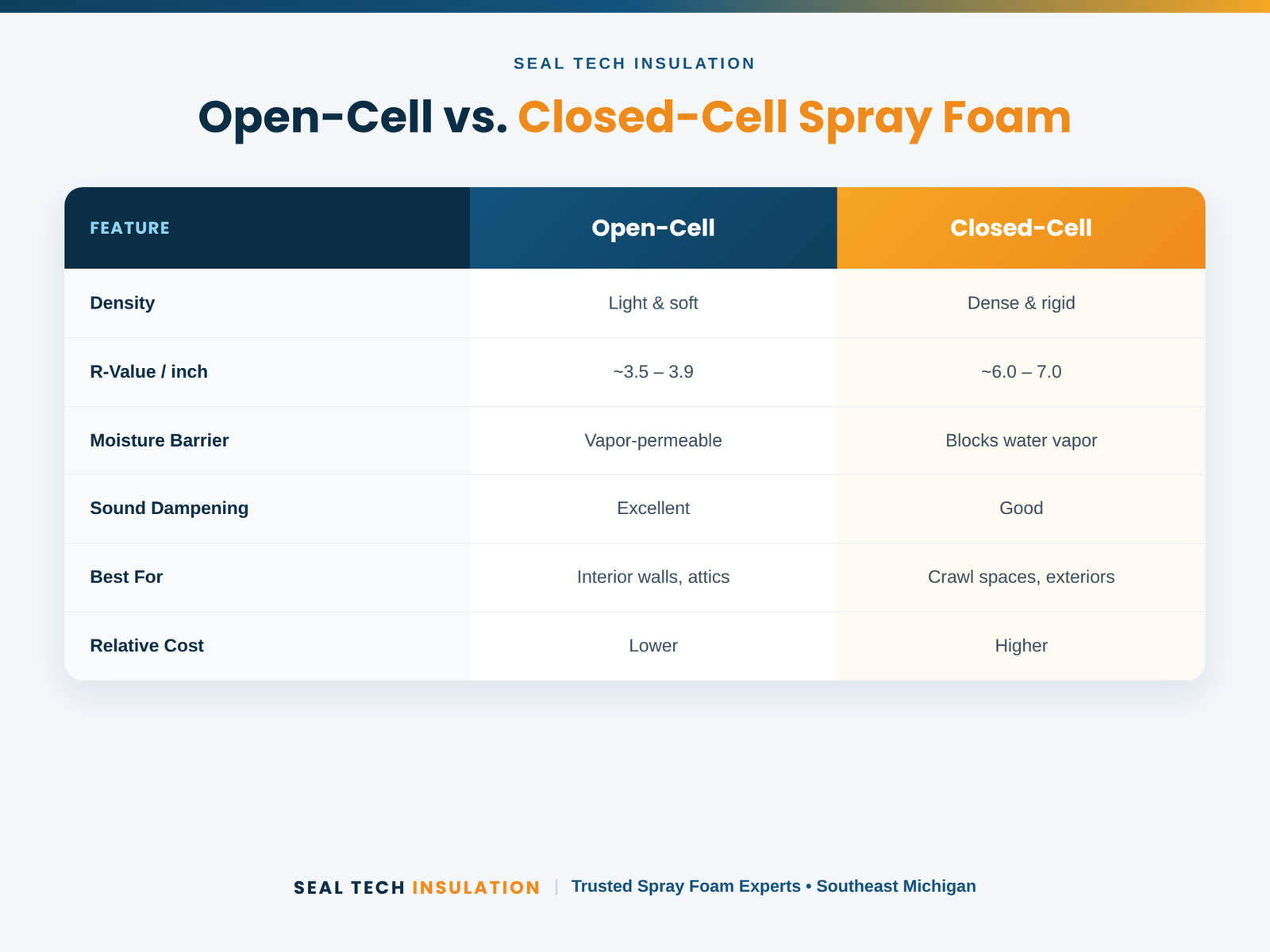
At a glance, the two foams differ across a few key measures. Open-cell foam is light and vapor-permeable, with an R-value near 3.5 to 3.9 per inch and excellent sound control. Closed-cell foam is dense and water-resistant, with an R-value around 6.0 to 7.0 per inch and added rigidity. Naturally, open-cell foam costs less, while closed-cell foam commands a higher price for its superior performance. Neither is universally “better”—the right choice depends entirely on the space you are insulating.
Understanding R-Value: Why It Matters
R-value measures how well a material resists heat flow, and it sits at the heart of the open-cell versus closed-cell decision. A higher R-value means better insulating power per inch of thickness. Closed-cell foam, at roughly 6.0 to 7.0 per inch, packs far more performance into a thin layer, which is a real advantage where space is limited. Open-cell foam, at around 3.5 to 3.9 per inch, needs greater thickness to hit the same target. However, because open-cell foam expands so much and costs less, it can still be the more economical way to insulate large, open cavities. In short, R-value is not the only number that matters—the right foam balances performance, space, and budget.
Differences in Moisture and Air Control
One of the most important distinctions is how each foam handles moisture. Closed-cell foam acts as both an air barrier and a vapor barrier, so it keeps humid air and water out of the assembly. This is why it is the go-to choice for basements, crawl spaces, and exterior walls. Open-cell foam, by contrast, stops air movement but still allows some vapor to pass through. In the right interior application, that breathability is perfectly fine and can even help a wall dry out. Understanding this difference is key to preventing moisture problems down the road.
Which Spray Foam Should You Choose?
The best foam depends on the location and your goals. For interior walls and attics where budget and soundproofing matter most, open-cell foam is often the smart pick. For crawl spaces, basements, exterior walls, and metal buildings where moisture control and maximum R-value are priorities, closed-cell foam is the clear winner. In many homes, the ideal solution actually combines both—closed-cell in moisture-prone areas and open-cell elsewhere. Because every home is different, professional guidance ensures each space gets exactly what it needs.
Cost and Value Considerations
Budget naturally plays a role in the decision. Open-cell foam generally costs less per board foot, so it stretches an insulation budget further across large areas. Closed-cell foam costs more, but it delivers higher R-value, moisture protection, and structural strength in return. Rather than simply choosing the cheaper option, it is wiser to match the foam to the job. Spending a little more on closed-cell in a damp basement, for example, can prevent expensive moisture damage later. Meanwhile, saving with open-cell in a dry interior wall puts your money where it counts. This targeted approach delivers the best overall value.
Where Each Foam Works Best in Your Home
In the attic, both foams can perform well, though open-cell is often chosen for cost and coverage. In crawl spaces and basements, closed-cell foam controls dampness and cold floors. For new builds, an installer can specify the right foam for each assembly from the start, which is why spray foam is a popular choice for residential new construction. To see how these foams fit into the bigger picture, our complete spray foam insulation guide walks through every application.
Frequently Asked Questions
Is closed-cell foam always better than open-cell? No. Closed-cell offers higher R-value and moisture resistance, but open-cell is more affordable and better at soundproofing. The best choice depends on the space.
Can I use both types in one home? Yes, and many homeowners do. Using closed-cell in damp areas and open-cell elsewhere balances performance and cost effectively.
Which foam is better for a Michigan basement? Closed-cell foam is usually the right call, because it resists moisture and delivers a high R-value in below-grade spaces.
Not Sure Which Foam You Need? We Can Help
Choosing between open-cell and closed-cell foam is easier with an expert on your side. At Seal Tech Insulation, we assess your home, explain your options in plain language, and recommend the right foam for every space—all backed by a limited lifetime warranty. Serving Detroit, Ann Arbor, Lansing, Toledo, and nearby communities, we make the decision simple. Contact us today for a free consultation and estimate and get the right foam for your project the first time.
Further reading: Where to Insulate in a Home (U.S. Department of Energy).
Ready for a more comfortable home?
Get a free, no-pressure estimate from the Seal Tech crew. Spray foam, attic, wall and crawl space insulation across Southeast Michigan, backed by a lifetime warranty.