
For business owners, every dollar spent on wasted energy is a dollar that could be working elsewhere. Yet many commercial buildings across Southeast Michigan leak conditioned air through poorly sealed walls, roofs, and metal panels. That waste drives up utility bills month after month and makes interiors harder to keep comfortable. Fortunately, commercial spray foam insulation tackles the problem at its source. By sealing and insulating in a single step, it lowers operating costs, protects the structure, and improves comfort for everyone inside. Here is what every business owner should know before investing.
Signs Your Commercial Building Needs Better Insulation
Many businesses tolerate the symptoms of poor insulation without realizing the cause. If your utility bills keep climbing without a matching rise in usage, air is likely escaping through the building envelope. Uneven temperatures from one area to the next are another red flag, as are persistent drafts near loading doors and windows. In metal buildings, visible condensation or “sweating” panels point directly to an insulation gap. HVAC systems that run constantly yet never quite keep up are also working overtime to compensate for lost air. When you notice these signs, upgraded insulation almost always delivers a quick and measurable improvement.
What Is Commercial Spray Foam Insulation?
Commercial spray foam is the same high-performance material used in homes, applied on a larger scale to warehouses, offices, retail spaces, and metal buildings. When sprayed onto a surface, it expands to fill every gap and then cures into a durable, airtight barrier. Because it seals and insulates at once, it eliminates the drafts and thermal gaps that plague traditional insulation. Consequently, businesses gain tighter climate control, lower energy demand, and a more consistent indoor environment across large open spaces.
Key Benefits for Your Business
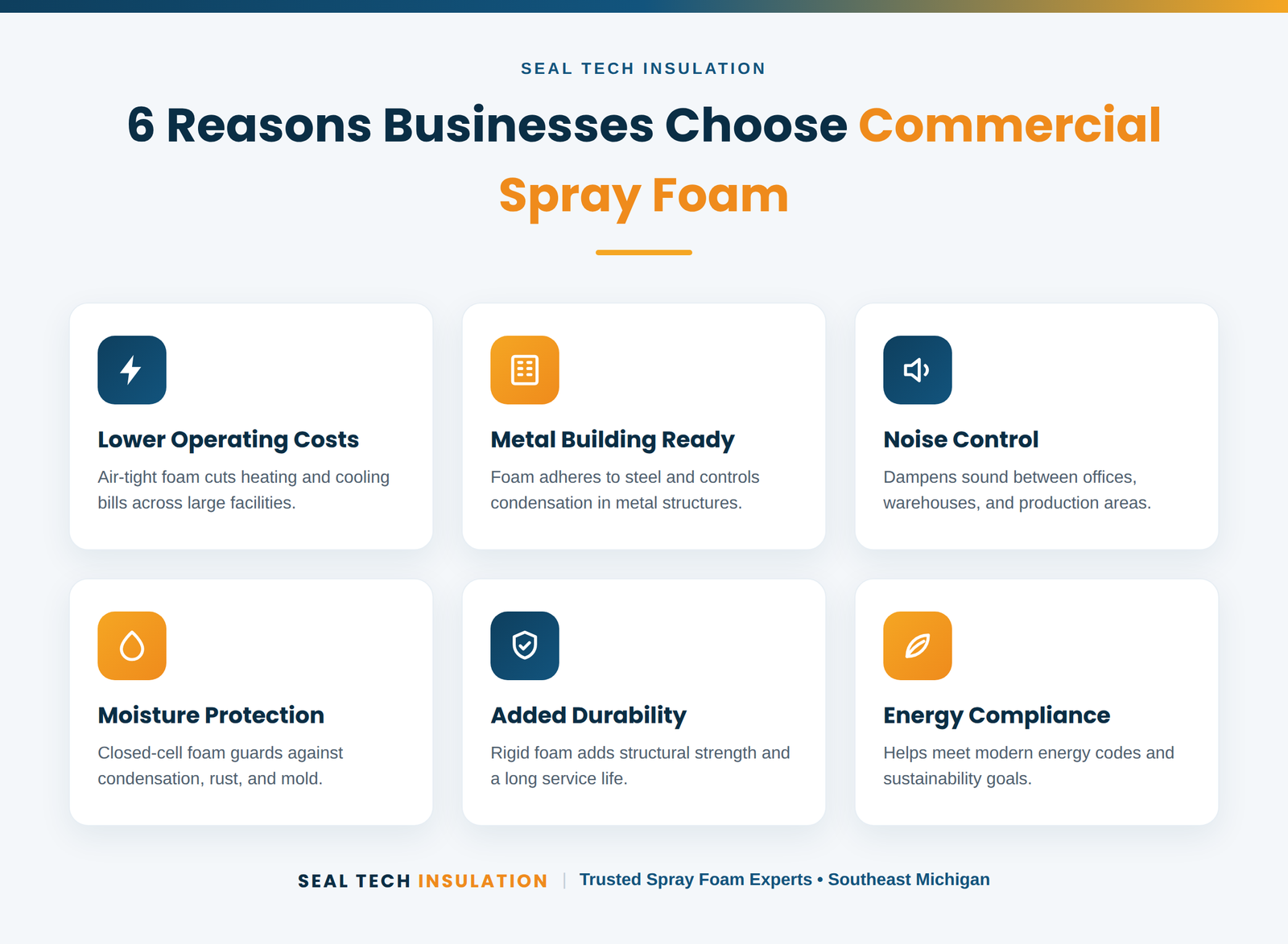
Lower Operating Costs: An airtight building envelope reduces the load on heating and cooling systems, which cuts monthly utility bills across large facilities.
Metal Building Performance: Spray foam adheres directly to steel and controls the condensation that often forms inside metal structures, protecting equipment and inventory.
Noise Control: Dense foam dampens sound between offices, warehouses, and production areas, creating a more focused and comfortable workplace.
Moisture and Mold Protection: Closed-cell foam blocks water vapor, and therefore it helps guard against rust, rot, and mold that can damage a building over time.
Added Structural Strength: Rigid closed-cell foam reinforces walls and roof panels, extending the service life of the structure.
Energy Code Compliance: High-performance foam helps buildings meet modern energy codes and supports broader sustainability goals.
Where Commercial Spray Foam Works Best
Spray foam performs well across a wide range of commercial applications. It insulates warehouse walls and roofs, seals office buildings for consistent comfort, and protects cold-storage and production facilities from temperature swings. It is especially valuable in metal buildings, where condensation control is critical. For companies planning a build-out, foam integrates seamlessly into commercial new construction, delivering efficiency from day one. Because each facility has unique demands, a professional assessment ensures the right foam and thickness for every area.
Types of Commercial Buildings That Benefit
Almost any commercial structure can benefit from spray foam, but some see especially dramatic results. Warehouses and distribution centers gain tight climate control over huge volumes of air, which slashes energy waste. Office buildings enjoy consistent, comfortable temperatures that keep employees productive. Retail spaces stay welcoming for customers without runaway utility bills. Manufacturing plants and cold-storage facilities depend on precise temperature control, and foam helps hold it. Finally, agricultural and metal buildings rely on foam to fight condensation and protect valuable equipment. In each case, the airtight seal delivers benefits that traditional insulation cannot.
How the Installation Process Works
A professional commercial installation begins with an assessment of the building and its goals. The crew then prepares the area, protects surfaces that should stay foam-free, and applies the foam in controlled passes to reach the specified thickness. Because the material cures quickly, large sections can be completed efficiently. Experienced installers also follow strict safety and ventilation procedures throughout the job. Afterward, the space is cleaned and inspected to confirm complete, even coverage. With proper planning, the work can often be scheduled to limit any disruption to daily operations.
A Smart Long-Term Investment
While spray foam carries a higher upfront cost than basic insulation, it should be viewed as an investment in your building’s performance. The ongoing energy savings, reduced maintenance, and extended structural life often deliver a strong return over the years. In addition, a more comfortable, quieter environment supports productivity and protects inventory. To understand the full range of advantages, it helps to review the broader benefits of commercial insulation before deciding.
There is also a sustainability angle worth considering. A building that uses less energy has a smaller carbon footprint, which supports corporate responsibility goals and can strengthen your brand with eco-conscious customers. In some cases, energy-efficiency upgrades may qualify for utility rebates or tax incentives, further improving the return. When you weigh reduced operating costs against these added advantages, spray foam stands out as one of the most impactful improvements a building owner can make.
Frequently Asked Questions
Is spray foam good for metal commercial buildings? Yes. It bonds to steel, seals gaps, and controls condensation, which makes it one of the best options for metal structures.
Will spray foam disrupt my business operations? A professional crew plans the work to minimize downtime, and many projects can be scheduled around your operating hours.
How long does commercial spray foam last? When professionally installed, spray foam can last the life of the building without sagging or settling.
Insulate Your Commercial Building the Right Way
Cutting energy waste starts with a tighter building envelope. At Seal Tech Insulation, we help businesses across Detroit, Ann Arbor, Lansing, Toledo, and the surrounding region insulate warehouses, offices, and metal buildings for lasting efficiency—all backed by a limited lifetime warranty. Contact us today for a free commercial estimate and discover how much spray foam insulation can save your business.
Further reading: Find Rebates for Commercial Buildings (ENERGY STAR).
Ready for a more comfortable home?
Get a free, no-pressure estimate from the Seal Tech crew. Spray foam, attic, wall and crawl space insulation across Southeast Michigan, backed by a lifetime warranty.