
Serving Southeast Michigan Since 2000
Does Spray Foam Insulation Really Reduce Drafts?
Does Spray Foam Insulation Help Reduce Drafts? Yes — Here's Why
Does spray foam insulation reduce drafts? Yes — if you've ever felt a cold draft near an outlet, baseboard, or window on a windy Michigan day, you already know the problem isn't just "not enough insulation," it's air leaking straight through your walls. Traditional fiberglass batts and blown-in insulation slow down heat transfer, but they don't stop moving air. Spray foam insulation does both: it insulates and air-seals in a single application, which is why it's one of the most effective fixes for drafty rooms in older Southeast Michigan homes.
Seal Tech's team explains exactly why drafts happen and how spray foam solves the problem for good. For more on how air sealing affects home comfort and energy use, see the Energy Star Seal & Insulate program and the U.S. Department of Energy's guide to air sealing.
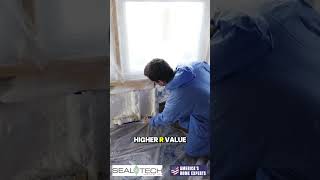
Video Summary — Does Spray Foam Reduce Drafts?
0:00 - The question: Our team addresses one of the most common comfort complaints homeowners bring up: cold drafts that persist even after adding "more insulation" the traditional way.
0:10 - Why fiberglass doesn't stop drafts: Fiberglass batts are designed to slow heat transfer, not block airflow. Gaps around outlets, top plates, rim joists, and penetrations let outside air move through the wall assembly no matter how thick the batt is — that moving air is what you feel as a draft.
0:28 - How spray foam is different: Spray foam expands on contact and fills every crack, gap, and penetration it touches. Because it bonds directly to the framing and sheathing, it creates a continuous air barrier — there's no path left for outside air to sneak through.
0:45 - What homeowners notice: Most customers report the difference within the first heating or cooling cycle after installation — fewer cold spots near exterior walls, less noise from outside, and a thermostat that no longer has to fight constant air infiltration to hold a steady temperature.
How Spray Foam Eliminates Drafts: Step by Step
-
Identify the Draft Sources
Our technicians inspect the areas most prone to air leakage — rim joists, attic penetrations, exterior wall cavities, and around windows and doors — to map out exactly where outside air is getting in.
-
Prep the Area
Any old, compressed, or ineffective insulation is cleared from the cavity so spray foam can bond directly to the framing and sheathing rather than an existing air gap.
-
Apply Spray Foam
Open-cell or closed-cell spray foam is applied and expands in place, filling every irregular gap and penetration — including the tiny cracks that fiberglass simply can't reach.
-
Continuous Air Seal Forms
As the foam cures, it creates one continuous, bonded air barrier across the entire treated area — eliminating the gaps that let drafts through in the first place.
-
Immediate Comfort Difference
With the air barrier complete, drafts stop, room-to-room temperature swings even out, and your HVAC system no longer has to work overtime to offset constant air infiltration.
Common Draft Sources — and How Spray Foam Seals Them
| Draft Source | Why It Happens | How Spray Foam Fixes It |
|---|---|---|
| Rim joists / band joists | Often left with little to no insulation in older homes | Sprayed directly onto the joist, sealing gaps completely |
| Attic penetrations | Wiring, plumbing, and duct chases create gaps into the attic | Foam expands into irregular openings fiberglass can't fill |
| Exterior wall cavities | Batts settle or were never cut tightly around obstructions | Foam bonds to framing, leaving no air gap |
| Around windows & doors | Gaps between the frame and rough opening | Sealed as part of a full building-envelope approach |
| Electrical outlets on exterior walls | Boxes are rarely air-sealed during original construction | Surrounding cavity is sealed, cutting off the draft path |
Why Drafts Are Especially Common in Older Southeast Michigan Homes
Michigan winters put real stress on a home's building envelope, and a lot of the region's housing stock — from postwar ranches to older colonials — was built with minimal air sealing by today's standards. Over decades, settling insulation, aging weatherstripping, and gaps around additions or remodeled areas make drafts worse, not better. Spray foam directly addresses the root cause instead of just adding more material on top of the problem.
Comfort tip: If certain rooms are consistently colder than others, or you feel air movement near outlets and baseboards on a windy day, that's usually an air-sealing problem — not a thermostat problem. A spray foam evaluation can pinpoint exactly where the leaks are before you spend money chasing the wrong fix.
Seal Tech Serves All of Southeast Michigan
Seal Tech Insulation installs spray foam insulation for homeowners dealing with drafts, cold rooms, and high energy bills across Southeast Michigan. We serve:
Feeling Drafts in Your Home?
Schedule a free evaluation and we'll pinpoint exactly where air is leaking in — before you spend another season fighting it.
Get Free Evaluation 📞 (866) 775-3626

📍 Serving All of SE Michigan
We fix drafty homes with spray foam insulation in Ann Arbor, Canton, Plymouth, Brighton, and 20+ more cities across Southeast Michigan.
Check Your Service Area →
As seen on America's Home Experts, Seal Tech Insulation is a trusted provider of spray foam insulation, attic insulation, and crawl space solutions throughout Detroit and Southeast Michigan.
Tired of Chasing Drafts Room to Room?
Free, no-pressure evaluation — we'll show you exactly where the air is getting in.
Schedule Free Evaluation 📞 (866) 775-3626